It’s Energy Independence, Stupid – Not Global Warming

By Lloyd Frazier

algore-global-warming If you are like me, you must be completely sick and tired of being sick and tired of the fiasco called “Global Warming.”  The media feeds this frenzy by putting so-called ‘experts’ like Al Gore in the limelight.  A day does not go by without a newspaper article, newscast, or a talking head on a talk show spouting doom and gloom.  If you have enough money, power, and a lot of lemming-like followers, you too can become a well known global warming expert.  Opposing scientific views from people that have dedicated their life to the study of climate and the environment…phooey….what do they know?

Global warming has become the biggest political football since the last catastrophic prediction back in the 70’s that we would all be needing snow sleds to get around.  It has become one of the largest, far reaching power grabs in the history of mankind.  Governments, right now, as you are reading this, are conjuring up laws concerning CO2 emissions from vehicles, factories, or whatever.  These laws will impact generations to come.  Decisions have been made that will impact how we live, work, and travel.  Our existing way of life is being manipulated by ignorant leaders and politicians based on one-sided, junk science just so that they can assure their position of power and leadership.  Global treaties have been created that will keep poorer nations from achieving a better life for themselves because of all the hydrocarbons they may create from their growing population of cars and factories.

Billions of dollars have been spent on research and equipment just in the U.S. alone.  There are many varying opinions on the results of all the findings from the many years of research.  For some reason, dissenting opinions from well respected scientists and professors have been squelched.  What happened to open debate?  Many of those who have an opinion that do not align with the new world religion called ‘Global Warming’, are afraid to speak up because they fear for their lively hood and career.

I ran across a website that has many links to information that debunks the global warming myth.  Go to Global Warming is a Farce and check the sources for yourself.  On discovery.org, you will find a fascinating video of the Telecosm 2007 – The Global Warming Myth – Dr Noah Robinson.  Here is an article on Fox News about John Coleman, who founded the Weather Channel network in 1982, who suggests suing for fraud  the proponents of global warming, including Al Gore, and companies that sell carbon credits.  As you know, carbon credits have become a huge financial commodity in our world.  There are as many or more sources that disprove the global warming argument as there are that agree with it.  It is time for our citizens in the U.S. to tune out and look beyond the mainstream news sources.  Wake up America!  We are being duped!

The biggest, best, and most important reason for kicking our oil addiction is to be energy independent.  We need to focus our time and efforts on discovering and creating better energy sources here at home.  The less dependent we are on foreign sources of energy, they better off we all will be.  If not for us now, then for our children and grandchildren.  Come on people, wake up and finally make a concerted effort to be informed beyond your typical, intellectually lazy news sources.  Sorry, but I agree with GM vice-chairman Bob Lutz – human caused global warming IS a crock of sh*t!

Lloyd…signing out!

Sportsmobile – Not Your Standard RV – Part 6

By Dave Boyer

Welcome back to Autoramblings “Specialty Vehicles??? section.

The last posting of this ongoing article mainly touched on the vehicle’s body, drive train, and engine. This portion will go over models, floor layouts and some of the basic interior features. It will also go cover a few other choices that were available in 2006. Again, due to the number of options available, the articles will be in parts, so revisit Autoramblings.com from time to time to catch the updates.

To see better detailed pictures of several vehicles coming off the line at Sportsmobile West, go to this link: My Sportsmobile Forum Pictures

This is my personal album that has pictures of various models as well as interiors constructed by SMB plus a close up look at suspension work done by Quigley and Sportsmobile. Feel free to browse through this album. I have also thrown in some pictures of Sprinter models and a few shots of my rig on the trail. I will update this album frequently so return now and then to take a look. You will also find several images of vehicles from others members of the Forum in their albums.

Models Review

The interior design will probably be difficult to decide on for many perspective buyers. SMB’s web site shows some basic models and their inside arrangements which will help to get you started. Because I am on the larger side of life, it was an easy choice on my part. If you’re lucky to be thin and shorter than six foot, almost any design should work for you depending on what you’re after. The layout can be configured in several ways. SMB has pre-arranged floor patterns available, but other than juggling components around, the models are really broken in to only a couple of types: those you can walk through the van to the back, and those you can’t. Just decide which one best suits your needs.

Here are a couple of typical layouts that many order. Both shots are looking toward the back. The seats shown here can transform into a bed.

clip_image002


clip_image004


This model has four seats for the comfort of a larger family or passenger transportation.

clip_image006


There is a lot of tweaking that can go on, so this is where a trip to SMB really counts. I had looked at the 4×4 vans we have at work and could not see fitting into one. Even a stock empty van looked very cramped and climbing into one didn’t help at all. In fact, it made it feel even smaller. I called SMB to satisfy my curiosity and Lynn (who primarily deals with used Sportsmobile’s) talked me into coming down to look at one. She said they actually appear somewhat larger with the top up and I would be surprised. My first trip to SMB changed my view. She was correct and I was amazed how much larger they looked than our work vehicles. I really liked the 50 model because of how much room and storage it appeared to provide.

clip_image008


The 50 model has a couch that sits crossways toward the back. This couch folds down into a large bed that is better suited for two people than the upper penthouse bed. Another nice advantage to the 50 model is that when the bed is in the couch configuration, there is ample storage available on top of and underneath the back portion of the bed.

clip_image010


Of course if you need to use the lower bed, the stuff sitting on top has to be put somewhere. I have been situations where high winds made it necessary to lower the top and move to the lower bed. I was able to jam most of my equipment up front. But I carry more than the average camper, so it’s not an issue for most folks. With the walk through models, the layouts generally have a couch or “gaucho??? located on one side of the van that also folds down into a bed such as this model in the picture below.

clip_image012


clip_image014


This setup provides a walkway to the rear doors. Although there are many ways to tweak any design to suit your needs, the picture above is the type of layout which many people choose that provides a spot for a marine head, or even a dedicated bathroom with shower just be aware it will take up valuable space.

clip_image016


This custom build 4X4 provides a back bed configured for wheelchair access.

Some “walk through??? models have a dinette area in the back that also can convert to twin beds. These models are popular with owners who prefer a Voyage top as seen in the image above and below.

clip_image018


Remember, many variations are possible. I have seen vans without a penthouse top, rigs with rear bucket seats for passengers, and even bare bone vehicles with very little built into them such as this custom van below.

clip_image020


There are many ways to configure a custom van and although I prefer the 50 model, others may want something different. That’s one of the advantages of a Sportsmobile.

clip_image022


clip_image024


If SMB has a vehicle similar to what you’re looking for, go take a look and see first hand.

While it is possible to order a van with little or no cabinetry, a person who decides to build their own interior might run into problems that companies such as Sportsmobile have resolved due to their expertise and years of design. It’s certainly possible to build your own van with better quality, but it must be planned out correctly. Building a van as tough as a tank might be a great idea until it’s taken to the scales and you find out it weighs close to a real tank. Just think of the waste in time and money if you have to pull out half of what you installed because it’s over weight. My van weighs in at 11,500 pounds, very close to maximum with all components installed by SMB. Can a better built van be constructed? Sure, anything can be improved on. With the time and expertise on your side, it could be an interesting project and possibly save you some money.

The next posting will cover some of the interior items starting with a few flooring options.

Thank you for visiting autoramblings.com.

Dave Boyer

Loremo – A Car For The Times?

By Lloyd Frazier

Loremo.final_blau The oil balloon is just about ready to pop.  In the U.S., we are probably looking at $4/gallon gas by the summer.  Just a couple months ago, there were rumors that oil was going to trend down slightly and we were going to hover just under $3/gallon this year.  When you look at the overall picture, globally, we only saw a 2% increase in consumption.  Oil companies are making record profits.  OPEC is keeping production at its current level.  Investments in oil futures is high.  Bottom line – oil has become the monster we all learn to live with because our lives are so ensconced by its presence.  In order for people to break away from this monster and regain our energy independence, new ideas and technologies need to be embraced.  Personal transportation is of key importance for maintaining liberty and independence.  Without affordable, reliable personal transportation, a person is relegated to the masses and governed by the whim of public transportation. 

High mileage automobiles are nothing new.  They have been around since the turn of the 20th century.  Most early concepts were just novel ideas meant to spark the imagination.  Economics is what really drives necessity.  It is prime time for high mileage cars.  Manufacturers are already churning out cars that squeeze more mileage out a gallon of gas.  Mileage in the 30’s to low 40’s has become more common.  We need cars that get ‘unreal’ mileage.  Something in the neighborhood of 100 mpg has become the new moving target for car manufacturers.  Gas-Electric hybrids have become mainstream.  Most average a 15-20% increase over the same model with a gas engine.  Pure, 100% electric cars have been making inroads due to improving battery technology.  The good ones are very pricey, like the Tesla.  The affordable ones like the Zap are either too slow, don’t have a useful mileage range on a charge, or cannot meet stringent U.S. safety standards.

The Germans, like the Americans, love fast, powerful cars.  The German Autobahns allow for high, sustainable speeds that are a perfect fit for them.  And like the American auto manufacturers, German companies like Mercedes have been chided for their line of gas guzzling vehicles.  What more perfect environment for a small company to surface that offers that ‘unreal’ mileage from an automobile.  Loremo AG, out of Munich, Germany was founded in 2000.  They design and manufacture cars with very low weight and air resistance.  Loremo is an abbreviation for Low Resistance Mobile — Lo-Re-Mo.  The car was originally conceived for emerging markets, but now has jumped into the limelight due to high oil prices and global warming concerns.  Mass production is slated for 2009.  A factory still needs to be constructed.

loremo_013

When you start to look at the car, things jump out at you.  Notice that there are no door lines.  The way the driver and front seat passenger enter the car is through lifting the whole front end.  The windshield and front clip are all one piece.  It just pulls forward and tilts forward.  You actually step into it.  There are videos on the Loremo site that demonstrates how that is done.  After thinking about that for awhile, I started to realize that, if you happen to be in a middle of a downpour, the car is going to get wet inside.  At least with a conventional car, you can slide in without letting water in.  Loremo’s reasoning behind this engineering design is to allow for greater rigidity with less weight.

loremo_006

There is some nifty electronics as well.  There is a module that combines internet, GPS, operational information, and entertainment all in one compact monitor design.  What happens when this gets drenched!?  I am sure those clever Germans have that covered.

loremo_001

Since this is a four passenger vehicle, you may be wondering how they get in for the ride.  Exactly like the driver does, except from the rear panel that tilts rearward.  They just step in as well.  As I mentioned, you can visualize how this works by visiting Loremo’s website.  I ponder on another observation.  This would not work well for elderly folks.  In a conventional car, you just back your fanny into the seat and then rotate your hips to get your legs into the car and your in.  Very easy for most older individuals and those with some mobility issues.  I just cannot see those types of people buying one of these vehicles.

3/4_Heck_ 0003

Overall, the car appears, in concept and design, to be just what the doctor ordered for overcoming the OPEC blues.  They will be offering two models with diesel engines.  The LS model will be able to achieve 157/mpg.  Yes, you read that correctly, but I will wait while you go get your reading glasses to confirm your suspicions.  Got ’em?  Good.  I stated…the LS model will be able to achieve 157/mpg.  And, the LS model will be selling for less than 15,000 Euros.  So what does that translate in US bucks?  Well, as of this writing, 1 Euro = 1.5383 US dollars.  So that makes it approximately 23K in our neck of the world.  That’s the price of a base Toyota Prius.  And the payback is 3 times quicker.  There will also be a GT model that only gets…pardon me if I sound a bit giddy…ONLY 104/mpg.  They will be offering an all electric as well.  Just to give you perspective on the LS model.  It will have a  maximum speed of 100 MPH, and it can do that in 20 seconds. It will have a 5.28 US gallon fuel tank that can take you 808 miles!  It all just seems so surreal, doesn’t it?  The question is, will we ever see something like this in the US?  To quote a famous Texan, Hank Hill….”I tell you what”, someone stands to make some big bucks if they are able to sell these here.  Suddenly, the Chevy Volt seems so yesterday.

Lloyd, signing out…

Alternative Fuels – Junk Science or Probability

by Lloyd Frazier

altenative_energy Almost on a daily basis, there is a theory or breakthrough on new fuel alternatives for our gasoline thirsty cars.  There is a current article on the New York Times site about turning atmospheric carbon dioxide into gasoline.  There is a very good rebuttal on the Climate Progress blog as well.  Every time a new, possible alternative is touted, an equal or better rebuttal is presented.  It is more of the same.  In the late 80’s, I  attended a science demonstration at the college where I was enrolled.  It was a demonstration of super conduction.  Remember that boondoggle?  By super freezing ceramic magnets with liquid nitrogen, they made them levitate.  It seemed very exciting at the time.  But, there were huge scientific road blocks to overcome.  Shortly after that, some scientists at a Utah university claimed they achieved cold fusion which since has been refuted.  Then came the critics saying universities were competing for funding and that is what brought about these demonstrations of miraculous scientific discoveries. 

Now the focus is on energy alternatives that promise an end to our foreign oil addiction.  Just exactly how much of these new ideas are junk science meant to draw attention for funding and federal subsidies and what is legitimate is open to interpretation.  Quite frankly, the American public is growing weary and more skeptical than I can remember.  We have to draw a line in the sand at some point.  Common sense tells us that building a completely new fuel dispensing infrastructure is a monumental, hugely expensive undertaking.  That is why hydrogen is not in our near future.  Ethanol, be it either from corn or a cellulose source, seems to make more sense, but at what cost?  It requires vast swaths of land and almost as much energy to produce as energy you get in return – barely a net energy gain.  Some ethanol producers claim they are achieving up to a 7:1 energy output now, however.  One company, Coskata, in partnership with GM,  is working on refining a process they developed that produces ethanol out of waste.  That seems like a win-win there.  Bio-diesel is making inroads in the commercial market but not so for the everyday consumer, yet.  Just what is going to be the magic bullet?  Doesn’t electric vehicles make the most sense right now?  The infrastructure is already there.  The electrical outlet in your garage is your source.   Or, are we so addicted to the smell of gasoline and the rumble of that engine that we cannot go back?  I have to admit, that would be hard to leave behind.  There is something very emotionally satisfying about driving around in a car with a nice exhaust note when you press on the throttle.  Old habits die hard.  Current events dictate that we take action to wean ourselves from our oil addiction.  Less talk and more action is the equation.  Getting the federal government out of subsidizing farmers is one big step.  When governments subsidize things like this, they create artificial markets for products that really are not viable alternatives.  Give free reign to the entrepreneurial  equation.  If there is a buck in it, the cream will rise to the top.  Tax breaks for innovation is the real key.  It has worked for a lot of other things in the past.  Just quit throwing tax payer money in the wrong directions for crying-out-loud! 

Sportsmobile: Not Your Standard RV – Part 5

By Dave Boyer.

Welcome back to Autoramblings “Specialty Vehicles??? section.

The remaining portion will cover what options I ordered on my off road vehicle. Due its length it will be broken into parts. This will be the most opinionated portion of this blog and primarily reflects my views. From time to time I will discuss issues I have read about concerning problems that other owners have encountered. I have no way of verifying legitimacy of other people’s views on a particular issue, so it’s possible I might post some inaccurate statements. I will try to keep “rumor??? to a minimum. It is the readers responsibility to determine fact in this or any other Web post. There are several owners that are more knowledgeable who have owned these vehicles longer than I have. Many of these people belong to the two Yahoo groups and are more than willing to answer questions.

In the past posts I discussed the major steps on ordering a Sportsmobile. As a kid my mom and dad told me there is always somebody bigger and meaner than me. I took this into consideration when ordering my van. I wasn’t after the biggest or best vehicle rolling off the line. If you were to try this, it would be necessary to buy a new vehicle every year and spend boo-coo bucks just trying to keep up with the Jones’s. But it was now time to actually request what I wanted on my new vehicle. Every time you visit the SMB factory, more than likely there will be a new van coming off the line that is better than yours. Not to say I didn’t make upgrades during construction, as seeing other vehicles did make me re-evaluate my order and add several items. The SMB options form contains a detailed list of items and what they cost installed. More than likely SMB has added new changes to their catalog by now, but most of their production items haven’t varied that much since 2005. The list I am going to base this article off of is the 2005 option form. So if you’re in the market for a new Sportsmobile, it would be wise to contact SMB to see what’s now available. Also going on line should take you in the correct direction. Besides, in a year or so this article might be a little outdated, especially since Ford has made some major style changes forcing SMB to make changes also.

clip_image002[4]clip_image004[4]

Just because I am having trouble with some items, it doesn’t mean you will have the same problems. See if improvements have been made and make your own decisions. Many problems I had were resolved and may no longer exist. Please remember that there are several options I didn’t order, so get a list from Sportsmobile, look over the optimum possibilities, and use the Yahoo groups to research your choices.

One of the first rules is, “never say never???. I am doing things periodically with my vehicle that I didn’t plan on when I made my purchase. I based my original order on a few things:

1. Where I planned to take the vehicle

2. The terrain

3. Length of time spent at a single spot

4. Storage

5. Towing

6. Daily driving

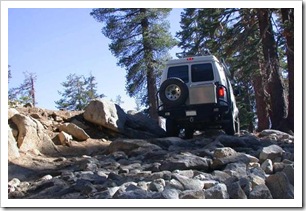
My views are quite different than when I made my purchase. Where I planned to take the vehicle and what kind of terrain I would go into changed dramatically once I found out what this thing could do. In the picture below, I was discussing a climb with Phillip, a forest service worker (on the right) who was having a recreational day himself. We followed him in and out of the area. The Sportsmobile climbed over rock better than his Jeep, but his vehicle took tight turns and narrow access such as the trees in the background much easier.

clip_image006


clip_image008

Sportsmobile’s are so large that most pictures will not show the degree of difficulty involved in a climb. On the contrary, Phillip’s Jeep really shows what the terrain actually was. This was an easy climb for a Sportsmobile but required a spotter to be on the safe side.

clip_image010

Off roading has become my main interest and unfortunately the van now sports scratches and dings as badges of honor to the 4×4 world. I wouldn’t have it any other way except for free body work.

clip_image012

If you find something you don’t like or question in the writings below, ask SMB or research it. I might be misinformed or just plain wrong!

The vehicle:

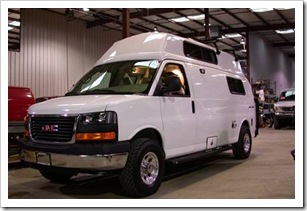
This was not even an issue for me, but others might disagree. I went with Ford because I believe the frame is stronger, and a big heavy rig like this needs the ability to resist tweaking on adverse, off camber situations as much as possible. Even though I’m a Chevy dude, I prefer the Ford while off roading for the stated reasons. As far as SMB 4X4 conversions, I’ve been told that the Chevy ride is far superior compared to the Ford E-350. I have seen some 4×4 General Motors vans, but they are usually more suited to light off road travel. Check out this great looking GMC/ Quigley 4X4 vehicle.
clip_image014

I decided on a white vehicle because I live where the summer heat is always over 100 degrees. I don’t know how metallic paints handle sun these days, but my rig will have to sit in full sun until I build a covered area to park it under, something I need to address soon. White stands up well to sun, stays cooler, is easy to keep clean, and more important, I like it.

The van’s length was a fairly easy choice also. First and most important was that I needed space for my astronomy equipment. The length between a regular body (RB) and an extended body (EB) is only about 20 inches, but it makes a big difference as far as inside storage, an advantage when traveling for extended periods. I am not sure, but it appears that the beds in the EB are longer (check with SMB) and at six foot, I wanted all the length I could get. The RB would be a better choice for heavy off roading but with a little finesse the EB does well. The EB has problems with departure angle (such as the lower rear bumper hitting the ground when driving out of a ditch) and tight turns on switchbacks. Usually you can calculate a drive into a gulch without dragging the ass end, but I have drawn a few lines in the sand with my hitch. As far as tight turns, the EB must make more multi point turns while driving on switchbacks and the like. So the RB wins here, but my rig gets the job done. The picture below required a spotter to help negotiate several very tight turns on a road in the eastern Sierra Nevada Range.

clip_image016

I have been told that the SMB 4×4 conversions turn sharper than their Quigley counter parts. This can be important for an EB depending on what you plan to do with the vehicle. The only problem I had on my decision to go with an extended body was that the RB was better looking, but that just my opinion.

The power plant was also pre determined before I ordered my rig. A diesel was first on my list. I was willing to put up with the extra noise, although the noise of the fan surprised me. Before I made my order to SMB, I was issued a new aerial lift truck at work that had an International Diesel motor in it. I drove it to the job site with no surprises. The first time I operated the boom, the fan kicked on while I was up in the air. My co-worker looked down and thought the truck had caught on fire. Not a great feeling when you are 70 feet up. There was a loud roar as we looked down to see what appeared to be smoke engulfing the engine area. Of course it was just dust. I had no idea how similar the Ford 6.0 power stroke diesel was to my work truck. While driving my new SMB home it took about 10 miles before the fan kicked in and all I said to myself was “O-NO???. I felt like…well some major mixed feelings kicked in about as hard as the fan did. You got to here this thing before buying one. Dura-max diesels don’t do this. I know of people who were totally freaked out when the fan kicked in on their 6.0 PSD. One person said they returned to SMB thinking a problem had occurred. Dust is the worst part, and this fan will really kick up the dust on some trails. Unfortunately I am forced to deal with it. The noise is just part of the van now and less noticeable to me at the present. Our work trucks sit at high idle for hours at a time, not to mention that they run about 10 hours most every day. Many of the older gas rigs had problems with heat, so we switched to diesel motors on equipment that idles up for long periods. But the newer gas engines are a new breed. I don’t want to talk anyone in to or out of the power plant they choose to put under the hood. We still use gas engines in meter reader trucks and electronic meter technician vans which have thousands of hours put on them in some of the worst conditions. A gas rig might be fine for your needs. Because of the weight of these rigs, I would go for the largest gas motor available if that was what I planned to order. At this point in time I would still order the 6.0 diesel. Just remember I said at this point in time.

For those who are hesitant about the purchase of the 6.0, watch this set of videos:

http://powerstrokehelp.com/PSD_common/6vs7/1of6.asp

Some of the pros of a 6.0 PSD are:

>It handles heat during long idle times better. Personally I feel that diesels handle heat better overall.

>It has good torque for pulling trailers and heavy loads.

(Note: I have been told the E-350 van 6.0 PSD has been de-tuned which produces less power and heat than the Ford pickup counterparts. This is to combat of limited air flow around the engine compartment.  The horsepower of the Ford Power Stroke Diesel in the Econoline van series  has been lowered about 100HP to accommodate for heat. The total HP output on my E-350’s PSD is about 235 @ 3300 RPM. Because of the heat issues, re-programming or “chipping??? the engine is not recommended. After the warrantee is up on my motor I might add a programmer for use in limited applications with close monitoring of EGT’s.

>It gets reasonable mileage. This is true especially when running a trail at slow speeds or on downhill grades. I have averaged about 13-14 MPG on a flat highway driving around 65 MPH. Driving slower speeds pushes up the mileage considerably. When traveling in the hills, I usually average 11 to 12 MPG. Pulling my SMB trailer doesn’t seem to make much of a difference on MPG in the hills.

>The motor should run longer before having to be rebuilt.

>Diesel is a by-product of gasoline and should be cheaper in price. I have no idea what happened here. New additives to fuel, hurricanes, and environmentalists give the oil companies an excuse to drive up prices on fuel. Conspiracy? It’s a bi-product for crying out loud.

>Diesel is actually more eco friendly than gasoline. (Don’t even think of arguing this point. Do your own research on it and make your own decision).

>Diesel fuel is much safer than gasoline.

<>This issue could be a pro or a con. Ford E-350 vans with the 6.0 PSD are used in ambulances all over the USA. I guess the best person to talk to would be a mechanic who works on fleet vehicles that run 6.0 Power Stroke Diesel vans. Don’t try to compare to a Ford truck. It’s a little different setup. Take a look under the hood of a Ford truck and then look at the van. Air flow is a major issue. Yet many times ambulance personal will keep their rigs running while sitting at their departure spot. They do this in all kinds of conditions, so the engines have to be somewhat reliable. I’m sure the major companies who utilize diesels have a reason why they use them over gas rigs, but who knows. I do know that the ambulance companies freaked when they found out the new ford 6.4 would not fit into the vans. The 6.0 is here to stay until a solution is found. A mechanic would be the person to say if a diesel is a pro or con, but even mechanics can be skewed one way or the other. Think about it. If a 6.0 is more difficult to work on than other engines, some mechanics will hate them even if they are better in the long run. Also remember the early 6.0 engines had major problems and I heard all kinds of bad reports. Bugs eventually get worked out as a rule. You always hear the bad because people complain and you rarely hear from those who have no problems. This is just human nature. I would rather not be a beta tester on a new motor though. You’re just rolling dice IMO. A very important fact is that people generally drive their work vehicles differently than their personal vehicles. Think about a Fire Department and how they use their rigs. Jump in and go. They drive them hard under heavy loads. More than likely they hit the road from a cold start. I believe strongly that cold short runs with a diesel aren’t a good thing.

Some cons:

<As I said, the 6.0 PSD has had its share of problems, most from the turbo charger. I have yet to have trouble with my motor (I’m knocking on wood as I write this), but I always pre-heat the motor to reasonable temps before heading out. In fact I usually pre-warm the motor before I start it in cold weather. (More on this later) IMO switching to synthetic oil will help with cold starts. I also watch the heat on long hauls and idle down the engine before killing it. It usually requires a 3 to 5 minute cool down before turning off the ignition after a hard run. On long steep grades, I periodically pull over and let it cool down. A pyrometer is a very valuable gauge. Too bad Ford doesn’t install these as a stock item, but they are in the business of selling and repairing. I plan to install a pyrometer soon.

<The motor is very expensive. Don’t think you will ever recoup the cost by fuel savings unless the oil companies go back to pricing fuel on what it really cost them to make it. We need to get some more refining plants going in the US. Diesel fuel subsidizes losses in other areas (IMO) or we are being ….well I’ll leave that out.

<The motor is noisy, hot, and smells like a diesel. The dog house (engine cover) gets really hot as does the front floorboard. The fan kicks up dust and sounds like a jet. If you don’t like diesel smell, take it into consideration. I never smell it in the van while driving unless I overfill the fuel tank. If that happens I will have to find a car wash ASAP. The exhaust isn’t that bad, but some find it irritating. Gasoline makes me noxious, but I actually kind of like the smell of diesel provided it’s not too overpowering.

<Diesel fuel is harder to find. But in a pinch, diesel might be easier to find around a farm or anywhere heavy equipment is being used.

<The motor holds 15 quarts of oil and is more costly to service.

<Repairs can be costly. I will say yes to extended warrantee when the time comes.

<Diesel fuel and extreme cold weather don’t like each other. The fuel can wax up and cause problems. When the Alaskan pipe line was built, they kept the diesel motors running 24 hours a day because of this. But this takes colder than average temperatures to cause problems. Special fuel blends plus strict procedures are required in colder climates. Synthetic oils are a big advantage because of their above average viscosity in cold harsh conditions. Getting oil to moving parts is crucial, and Synthetic’s move better than standard oil in freezing temperatures. Someone from a state like North Dakota could answer how they deal with this kind of weather. Another minor setback is that diesel foams up when pumping the fuel. A slow delivery is necessary to fill the tank. Some of this problem has to do with the aftermarket tank, where foaming is an issue.

In the upcoming post I continue on to some of the inside options.

See you on the trail.